Tuesday, March 3, 2009

Soup Base


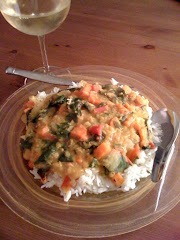
First of all, when you walk into a kitchen when someone is sauteeing garlic and onions in olive oil, you realize deep inside yourself that it will all be okay. The world may be falling apart but this simple aroma brings us back to what really matters. So, I thought I'd tell you just how simple it is to make any soup or stew without adding boullion or canned broth.

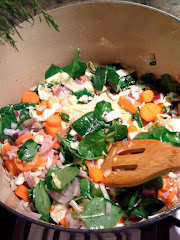
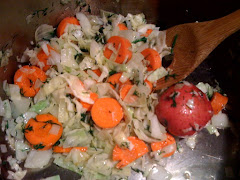
It always starts with an onion and olive oil. I never leave out garlic, even just one will add flavor. Telly always (most of the time) uses diced carrots and now so do I. Throw those three ingedients and sautee with olive oil on medium high.

Now I have a secret ingredient...cabbage, either purple or green, savoy or regular. You might not like cabbage and think this will ruin the taste but I say it adds flavor that is not distinguisable. Just take about 1/8 of a head and chop it very small and throw it in the sautee. Cabbage is so good for the skin. It has silicon and other minerals that are hard to find in other veggies. It also adds a slightly sweet taste to your dish. I remember my mother always adding a pinch of sugar to dishes to balance the flavors. Now I just add a little cabbage.

Telly has another vegetable that he loves to add to his base. Swiss chard! Again, just take 2 large leaves, chop, and sautee. This green leafy vegetable is loaded with vitamins and minerals. It adds color and flavor.

Last but not least, one can always add parsley to every dish. Again, the health benefits are fantastic and color and flavor go along with it.

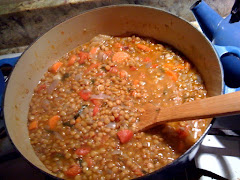
Now you have your base! You can make anything : )

Osteoporosis


OSTEOPOROSIS FACTS Why eating vegetables are better for you than animal products.

Osteoporosis most affects post-menopausal women.
American women aged 50 and older have one of the highest rates of hip fractures in the world. (Campbell, 9. 204) Americans consume more cows’ milk than most of the countries in the world. Australia and New Zealand have higher rates of hip fractures and are the only two countries that drink even more cow’s milk than the US.

The rate of hip fractures is a reliable indicator of osteoporosis. In 1992, Yale University School of Medicine conducted a study where the subjects were women over the age of 50. Seventy percent of the fracture rate was attributed to animal protein consumption. Yale University researchers explained that animal protein increases the acid in the blood and tissues. The body’s reaction to the acid is to try to balance it by neutralizing the acid.

The body uses calcium to neutralize the acid. Calcium is basic. The theory from the Yale researchers is that the calcium is pulled from the bones in order to neutralize the blood. The calcium loss weakens the bones putting them at risk for fracture.
This theory was first suggested in the 1880’s and again in the 1920’s. It is a well known fact that animal proteins increase acid levels in the blood. Also, it is a known fact that with this acidic environment, the amount of calcium in the urine is increased. “Doubling protein intake (mostly animal-based) from 35-78 g/day causes an alarming 50% increase in urinary calcium (Campbell, 206). Average Americans intake 70-100 grams of animal protein per day.

A study funded by the Atkins Center also found that people using the Atkins diet excreted 50% more calcium in their urine after 6 months on the diet (Campbell, p. 206).

In 2000, the Medical University of California at San Francisco did a study comparing vegetable to animal protein to bone fractures. They found there were virtually no fractures with those consuming vegetable proteins!

The Study of Osteoporotic Fractures Research Group at the University of California also published a study characterizing women’s diets by the proportions of animal versus plant protein. After 7 years of observation, the women with the highest ratio of animal protein intake to vegetable protein intake had 3.7 times more bone fractures than women with the lowest ratios (Campbell, p. 207). The study stated that women with the highest ratio of animal protein, lost bone 4 times as fast as the other women.

Studies show that eating a primarily vegetable based diet decreases your risk of osteoporosis!

Campbell, T. (2004). The China Study, pp.204-210.

Sunday, February 15, 2009

Constipation


Constipation

It’s embarrassing, uncomfortable, and irritating and it affects over 4 million people in the United States regularly!

What can we do about it? It’s important to understand the possible reasons behind it and why it is important to eliminate properly and on a regular basis.
Americans tend to eat a higher ratio of meat, dairy, and bread and while eating very little fruits and vegetables. For this reason little dietary fiber is consumed. At the same time Americans tend to drink soft drinks or juices over water. With these two actions combined, constipation is bound to happen (pun intended!) As well, the disproportion of animal products and vegetables upsets the normal balance of bacteria in the bowel.

It is important to eliminate large, formed, moist stools every day. For one, it is our bowel that absorbs nutrients. The small intestines have the incredible job of breaking down and distributing nutrients from food to all of our body. The small intestine consists of the duodenum where absorption of minerals takes place. Next is the jejunum where water soluble vitamins, carbohydrates, and proteins are absorbed. Lastly, the ileum is where fat soluble vitamins, fat, and cholesterol are absorbed. By the time food passes to the large intestine or the colon, water and some final electrolytes are absorbed. It is here that what is remaining waits to be eliminated. This is the waste products of what was eaten. While it is sitting here, bacteria are continuing to break it down.

The types of foods eaten determine the health of the large intestine. A diet high in fiber helps aid in the proper breakdown of waste products and also the proper elimination of wastes and toxins from the body. Putting it bluntly, if we do not eliminate our wastes, they start to be reabsorbed back into the blood stream, back up into the small intestines and begin burdening the liver, pancreas, and gall bladder. There are an estimated 148,000 annual cases of colorectal cancer in the United States! ( 107,300 annual cases of colon cancer and 41,000 annual cases of rectum cancer (SEER 2002 estimate).

What we can do!/strong

Eat a balanced diet of whole foods including fresh vegetables, fruits, legumes, and whole grains.

• Drink a glass of warm water upon arising from sleep to stimulate the bowel.
• Drink plenty of water throughout the day.
• Supplement with a whole food vitamin being sure to include magnesium and vitamin C.
• Add ground flax seed to baked goods, sprinkle over cereal or yogurt.
• Alternate psyllium with Triphala, (an Ayurvedic herb) to assist in elimination and bowel cleansing
• Take a pro-biotic supplement to balance the bacteria in the bowel.

Thursday, January 29, 2009

What's For Dinner?


I got this giant zucchini from a Biodynamic Winegrower in Drycreek Valley, Sonona and made the Zucchini Parmisano with quinoa flower and a tomato, fennel, basil, sauce served over pasta. Ciao, Telly

Wednesday, January 28, 2009

Telly's hungry. Let's Eat!


Nicole just made Gigantes which she will finish with feta and serve Greek Lemon Patates. Yiasou.

Monday, December 1, 2008

Digestive Health

Before I started studiing nutrition seriously, I began reading Bernard Jensen’s, Tissue Cleansing through Bowel Management. This remarkable book made me think differently about the disease process. Having been trained in conventional Western medicine as a nurse, I was taught to treat disease. More specifically, we have been taught to treat symptoms of disease. What I’ve learned from this book and other classes is that the root of many diseases actually comes from autointoxication. This is when toxins from food or environment are not eliminated from our bodies and in turn make us sick. Secondary to that, if the intestines are blocked or backing up, it makes absorption of vital nutrients more difficult. Blood to the colon begins to pick up toxins, or poisons from the bowel wall and deposit them back into the bloodstream. Constipation is the main culprit in autointoxication. Most people, including physicians think that if one stools once every one to two days, that this is sufficient. The fact is, that it is extremely important to eliminate after every meal one eats. It takes 18 hours from the time one eats a meal for it to go through the entire digestive process and be eliminated. Food or warm water in the stomach stimulates the bowel and assists in elimination. That’s why it is very important to drink warm lemon water upon waking in the morning, to stimulate undigested food in intestines and assist in elimination, before putting more food in the system. Another major problem with most people’s bowel is the lack of proper intestinal flora. Meat, coffee, sugar, alcohol, and many processed foods kill lactobacillus acidophilus (which need an acidic bowel) and feed bacillus coli (which love an alkaline bowel). In a normal healthy bowel, one should have 80% lactobacillus acidophilus and 20% bacillus coli. Most people on a western diet are the exact opposite, opening up a window for disease. In Bernard Jensen’s years of study, he found that people whose diets included fermented milk or yogurt (containing acidophilus), lived the longest. Having read this book, I did implement changes in my diet. Of course, every morning, I start off drinking luke warm purified water, at least one glass. A couple times per week my breakfast consists of a cup of Kefir (type of yogurt containing a higher protein, lower carbohydrate than regular yogurt). I sprinkle ¼ cup of ground flax seed on this drizzled with Agave nectar for sweetness. Alfalfa tablets may be taken after meals to provide natural fiber bulk. We should attempt to drink two liters of water everyday. For exercise, try to walk at least three times a week and the other days do stretches. Dr. Jensen is a firm believer in slant board exercises which get blood to your head and take some of the pressure off the bowel. When doing stretching, try poses which get the feet up in the air. Dr. Jensen’s book also discusses the benefits of colonics, fasting, juicing, broths, and enemas. Overall, it is important not to overlook our intestinal health.

Wednesday, October 29, 2008

Show Me The Food!

OK! You Keep Talking About Food. Bring it on!


People are always telling me that they couldn't possibly be a vegetarian because they would feel so weak and not have any energy. My feeling is that being a vegetarian for most people means taking the meat out of their cheeseburger at McDonald's and finishing off that bun with fries and a coke. So, sure. There is very little energy there except the short sugar high immediately afterwards. Most people are not sure how to start or what veggies to prepare. The concept of a meal with out the main dish being a meat is strange but with some education can be overcome. Learning how to balance your meals takes a little skill and some practice but can be seen as an exciting challenge.

My brother and I (and his beautiful wife) are always sharing recipes and especially photos of what exciting new dishes we have prepared. So, I was thinking about writing a cookbook with him. We both love nutritious whole food and taking pictures. Then I realized, that posting our photos and recipes here would be ideal. People are always asking me what I eat and how I cook it. So here it is. I will start by posting some of our beautiful dishes from the past year. We'll see how it goes. Enjoy...


The first photo is Greek Style Green Beans in a tomato, garlic,onion, and dill base.

The second photo is a pot of freshly picked pink eyed peas. I sauteed garlic, onion, and Swiss chard and then simmered the peas in that mixture.

The third photo is an creamy Italian mushroom risotto.

The next photo is a pot of yellow lentils not fully cooked.

Of course, the next picture is a Greek salad; cucumbers, tomatoes, and green onion drizzled with virgin olive oil but without the feta cheese!

The final photograph features rosemary hummus with rice crackers.